
If you've ever dealt with a water system that just won't hold pressure or a tank that's constantly running low when you need it most you know that storage and pumping aren't things you can bolt together and hope for the best. Across the UAE, from residential towers to warehouses and hotels, the heat, the fluctuating demand, and the sheer scale of some of these buildings mean the tank-and-pump combination has to be right from day one.
GRP tanks have become the go-to option for a lot of these projects, and for good reason they're tough, they resist corrosion, and they're far easier to install in awkward spaces than a lot of alternatives. But a good tank on its own won't solve your water problems. The pump feeding into it has to be matched to what the building actually needs, not just what looks good on a spec sheet.
For property owners, contractors, consultants, and facility managers searching for grp tank suppliers in dubai or dependable pumping equipment, it helps to understand how these two pieces actually work together because getting it wrong tends to show up later as pressure complaints, breakdowns, or equipment that wears out far sooner than it should.
GRP Glass Reinforced Plastic is essentially resin combined with glass fibre, which gives you a tank that's strong but nowhere near as heavy as steel or concrete alternatives. And unlike metal tanks, it doesn't rust, which matters a lot given the humidity and heat this region deals with year-round.
You'll find GRP tanks in all sorts of sizes and configurations, from small setups for a single villa to massive multi-panel installations for industrial sites. But here's the thing worth remembering when you're comparing a grp water tank supplier in dubai: capacity is only part of the story. The build quality of the panels, the internal lining, the fittings, how it's installed, and whether it's rated for potable or non-potable water all matter just as much, sometimes more.
Dubai isn't an easy environment for water storage equipment. Intense sun, high humidity, and long stretches of heat will expose weaknesses in a poorly built or badly installed tank fairly quickly. A well-specified GRP tank, though, tends to handle it without much fuss.
One mistake we see constantly: people size a tank purely off the square footage of the building. That's not how water demand actually works.
Real consumption depends on how many people are using the property, what type of building it is, operating hours, the number of bathrooms and fixtures, irrigation needs, and whether there's commercial activity involved. A restaurant and a residential block with the same floor area can have wildly different water needs.
A proper assessment looks at:
Working with experienced grp tank suppliers in dubai means you're less likely to end up with a tank that's either oversized (wasting money and space) or undersized (leaving you short when demand spikes).
The tank stores the water the pump is what actually gets it where it needs to go, and in most buildings, keeps the pressure at a usable level. This is exactly why picking the right water pump suppliers in Dubai isn't something to rush.
A common misconception is that a bigger motor means better performance. It doesn't, necessarily. What matters is matching the pump to the real hydraulic demands of the system:
Get any of these wrong and you end up with low pressure, high energy bills, constant cycling, vibration, noise or a pump that just wears out faster than it should.
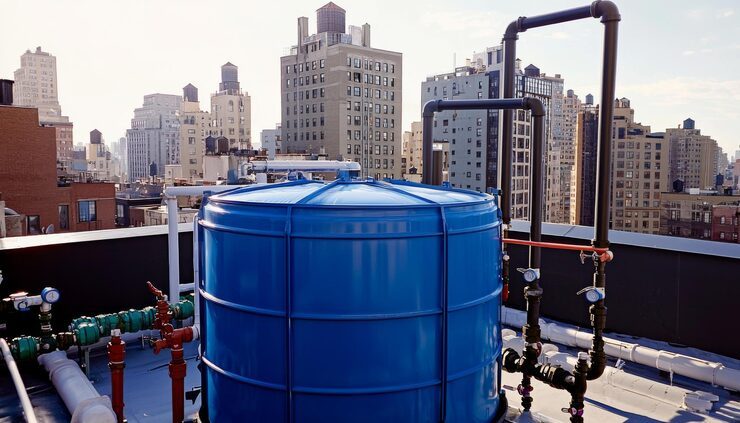
It's easy to treat the tank and pump as separate purchases, but they really function as one system. Water sits in the GRP tank, gets drawn into the pump, and is then pushed through the distribution network at whatever pressure the building needs.
Think about a high-rise versus a low-rise villa: the pump on the high-rise has to overcome serious static head on top of friction losses through the pipework, while the villa setup looks completely different. That's why tank capacity, pump capacity, pressure controls, and pipework really need to be designed together, not selected one at a time.
Different buildings call for different pump arrangements booster, transfer, pressure-boosting, or submersible, depending on what the site actually needs.
Again the right choice comes down to the application, not the horsepower rating on the box.
If you're weighing up options for a grp tank dubai project, here's what actually matters:
When you're comparing quotes from water pump suppliers in Dubai, resist the urge to shop by motor size alone.
Working with an experienced water pump supplier in UAE takes a lot of the guesswork out of the process from initial selection right through to installation and ongoing support. A good supplier should be asking about your application before recommending anything, not just pushing whatever's in stock.
For businesses and property owners across Dubai, Falcon Pumps supplies water pump solutions across residential, commercial, and industrial projects, helping customers land on the right equipment for their specific system rather than a generic one-size-fits-all setup.
Whether you're putting in a new system, upgrading something aging, or replacing a pump that's given up, getting a proper technical assessment done first makes a real difference down the line.
Once everything's installed, both the tank and pump need regular attention. A solid maintenance routine should cover:
Catching issues early is almost always cheaper than dealing with a full system failure later.
There's no single tank-and-pump combination that fits every building: a villa, an apartment block, a hotel, a warehouse, and an industrial site can all have completely different requirements. The smart approach is to assess the whole system first: figure out storage needs, calculate flow and head, look at the installation environment, then choose equipment that actually matches.
Whether you're researching grp tank suppliers in dubai, a grp water tank supplier in dubai, or water pump suppliers in dubai, don't let price be the only factor technical know-how and after-sales support matter just as much, if not more.
Get the system right, and you're looking at reliable water availability, steady pressure, lower running costs, and far fewer headaches down the road.
1. What are the advantages of GRP water tanks?
They're lightweight, corrosion-resistant, durable, and available in a wide range of capacities. Modular construction also makes them practical for large installs or tricky-access sites.
2. How do I choose the right GRP tank size?
Base it on actual water consumption, number of users, peak demand, required reserve, property type, and available space. For larger systems, get a professional assessment done rather than guessing.
3. How do I pick the right water pump?
Look at flow rate, total head, pressure needs, pipework, elevation, and the specific application. Horsepower alone won't tell you what you need to know.
4. Can GRP tanks store potable water?
Yes as long as the materials and internal components are specified for drinking water and meet the relevant standards.
5. Are GRP tanks a good fit for Dubai's climate?
Generally, yes the material handles corrosion well. That said, correct specification, installation, and ongoing maintenance are still what determine long-term performance.
